
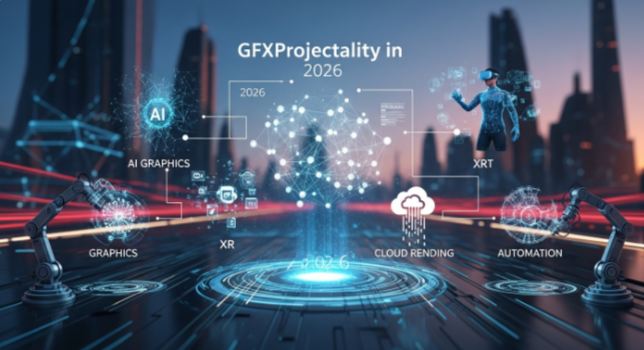
In the ever-changing environment of technology trends, tech trends gfxprojectality is proving to be a significant force by successfully integrating many new technologies, graphic innovations, immersive creativities, and futuristic project scalability. Businesses, individuals, developers, and marketers are all looking to find effective ways to incorporate many new technologies, graphic innovations, creativities, and more. What they are looking for is ultimately GFXProjectality.
Unlike other conventional tech trends based on hardware or software development improvements, a tech trend of GFXProjectality represents a full transformation containing those factors:
-
Artificial Intelligence in graphics
-
Cloud-based rendering and collaboration
-
Extended Reality (XR) environments
-
Automation in creative workflows
-
Data-driven design personalization
This article explores every major dimension of tech trends GFXProjectality in 2026, providing deep insights, practical applications, benefits, risks, and future predictions.
Understanding the Meaning of tech trends gfxprojectalityin Modern Technology
The term GFXProjectality can be interpreted as a fusion of:
-
GFX (Graphics & Visual Computing)
-
Project-based scalability and modular development
-
Reality-driven immersive digital environments
Together, they define a next-generation framework where visual technology is not just aesthetic—it becomes functional, intelligent, and interactive.
Key Characteristics
-
Real-time visual intelligence powered by AI
-
Cross-platform scalability across devices and clouds
-
Immersive interaction through AR, VR, and MR
-
Automated creative pipelines reducing manual design work
-
Data-responsive graphics adapting to user behavior
This shift marks the transition from static design to living digital experiences.
Why Tech Trends GFXProjectality Matters in 2026
The digital economy is now dominated by experience-driven engagement. Users expect:
-
Faster visual performance
-
Personalized interfaces
-
Immersive storytelling
-
Seamless cross-device continuity
Tech trends GFXProjectality addresses all these expectations simultaneously.
tech trends gfxprojectality: Market Drivers
-
Explosion of AI-generated visuals
-
Growth of metaverse-like environments
-
Demand for hyper-realistic simulations
-
Expansion of remote collaboration tools
-
Rise of creator-driven economies
Organizations that ignore these trends risk digital irrelevance.
Core Technologies Powering Tech Trends GFXProjectality
1. Artificial Intelligence in Graphic Design
AI is redefining how visuals are created and optimized.
Capabilities include:
-
Text-to-image generation
-
Automated animation
-
Smart color grading
-
Predictive layout optimization
-
Real-time visual enhancement
This dramatically reduces production time and costs while increasing creative possibilities.
2. Real-Time Rendering and Cloud Graphics
Cloud GPUs and edge computing enable:
-
Instant 3D visualization
-
Browser-based design environments
-
Collaborative rendering pipelines
-
High-performance gaming and simulations
This is essential for scalable GFXProjectality ecosystems.
3. tech trends gfxprojectality: Extended Reality (XR) Integration
XR combines Augmented Reality, Virtual Reality, and Mixed Reality into immersive digital spaces.
Applications include:
-
Virtual product showrooms
-
Interactive education environments
-
Remote industrial simulations
-
Immersive marketing campaigns
XR transforms graphics into experiential technology.
4. tech trends gfxprojectality: Automation and Generative Workflows
Automation tools now handle:
-
Asset generation
-
Scene composition
-
Motion design
-
UI responsiveness
This allows creators to focus on strategy and storytelling rather than repetitive tasks.
5. Data-Driven Personalization by tech trends gfxprojectality
Modern graphics adapt in real time based on:
-
User location
-
Behavior patterns
-
Device performance
-
Interaction history
This creates unique visual experiences for every user.
Major Industries Impacted by Tech Trends GFXProjectality
Gaming and Interactive Entertainment
The gaming sector is the largest adopter of GFXProjectality principles.
Key impacts:
-
Hyper-realistic environments
-
Procedural world generation
-
AI-controlled characters
-
Cross-platform rendering
Gaming is becoming cinematic, social, and persistent.
Digital Marketing and Branding
Brands now rely on:
-
AI-generated ad creatives
-
Interactive storytelling
-
Immersive product demos
-
Personalized visual campaigns
This dramatically increases engagement and conversion rates.
Education and E-Learning
GFXProjectality enables:
-
Virtual classrooms
-
3D simulations
-
Interactive science models
-
Gamified learning environments
This improves knowledge retention and accessibility.
Architecture and Engineering
Professionals use:
-
Real-time 3D modeling
-
AR-based site visualization
-
Digital twins of buildings
-
Simulation-driven planning
This reduces cost, risk, and construction errors.
Healthcare and Medical Visualization
Medical fields benefit from:
-
3D anatomy simulations
-
Surgical training in VR
-
AI-assisted diagnostics
-
Patient education visuals
This enhances precision and patient outcomes.
Benefits of Adopting Tech Trends GFXProjectality
1. Enhanced User Engagement
Immersive visuals keep users longer and more involved.
2. Faster Creative Production
Automation reduces design time from weeks to hours.
3. Cost Efficiency
Cloud rendering eliminates expensive local hardware.
4. Scalability
Projects can expand across platforms, regions, and audiences.
5. Competitive Advantage
Early adopters gain brand authority and innovation leadership.
Challenges and Risks to Consider
Despite its promise, tech trends GFXProjectality also presents challenges.
Technical Complexity
Advanced graphics systems require:
-
Skilled developers
-
Powerful infrastructure
-
Continuous updates
Ethical and Creative Concerns
AI-generated visuals raise questions about:
-
Originality
-
Copyright ownership
-
Deepfake misuse
Data Privacy Issues
Personalized graphics depend on user data collection, which must comply with regulations.
Cost of Transition
Switching from traditional workflows to GFXProjectality ecosystems can be expensive initially.
Future Predictions for Tech Trends GFXProjectality (2026-2035)
1. Fully AI-Generated Digital Worlds
Entire environments will be created instantly from prompts.
2. Persistent Metaverse Workspaces
Work, learning, and socializing will occur in shared 3D environments.
3. Brain-Computer Visual Interfaces
Users may control graphics using neural signals.
4. Photorealism Beyond Reality
Rendering quality will surpass real-world perception.
5. Autonomous Creative Agents
AI systems will manage entire design projects independently.
How Businesses Can Implement Tech Trends GFXProjectality
Step 1: Invest in Cloud-Based Graphic Infrastructure
Step 2: Integrate AI Design Tools
No 3: Explore XR Customer Experiences
Step 4: Train Teams in Real-Time Rendering
Step 5: Prioritize Ethical and Secure Data Usage
Organizations that follow these steps can future-proof their digital presence.
Best Tools Supporting GFXProjectality Innovation
Popular categories include:
-
AI image and video generators
-
Real-time 3D engines
-
Cloud rendering platforms
-
XR development frameworks
-
Automation-driven design suites
Choosing the right combination determines project success.
SEO and Content Creation in the Era of GFXProjectality
Even search engine optimization is evolving.
Visual-First Search
Search engines now analyze:
-
Images
-
Videos
-
3D content
-
Interactive media
AI-Generated Content Optimization
Creators must ensure:
-
Authenticity
-
Quality signals
-
Human value
Immersive Web Experiences
Future SEO will prioritize engagement depth, not just keywords.
tech trends gfxprojectality: The Role of Creators and Developers
Success in tech trends GFXProjectality requires hybrid skills:
-
Design thinking
-
Coding knowledge
-
AI tool mastery
-
Storytelling ability
-
Data interpretation
The future belongs to multi-disciplinary digital creators.
Common Myths About Tech Trends GFXProjectality
Myth 1: It’s Only for Big Tech Companies
Reality: Cloud tools make it accessible to startups.
Myth 2: AI Will Replace Designers
Reality: AI enhances creativity rather than eliminating it.
Myth 3: XR Is Just a Gaming Trend
Reality: XR is transforming education, healthcare, and commerce.
tech trends gfxprojectality: Practical Use Cases in Everyday Life
-
Virtual try-on shopping
-
Interactive travel previews
-
AI-generated social media visuals
-
Remote collaborative design studios
-
Smart home 3D control dashboards
These examples show how GFXProjectality is becoming mainstream.
Final Thoughts on Tech Trends GFXProjectality
Tech trends GFXProjectality represents more than a buzzword—it is a paradigm shift in how technology, creativity, and human interaction merge. As AI, XR, cloud computing, and real-time rendering continue advancing, the boundary between digital and physical reality will blur even further.
Businesses, educators, developers, and creators who embrace this transformation early will gain:
-
Stronger engagement
-
Faster innovation cycles
-
Global scalability
-
Long-term competitive dominance
Ignoring it, however, may lead to rapid digital obsolescence.
The future is not just technological—it is visually intelligent, immersive, and dynamically project-driven.
And at the center of that future stands tech trends GFXProjectality.